

A king's plea for sleep
A scene from Shakespeare that gave us the phrase "uneasy lies the head that wears a crown"

The Story So Far…
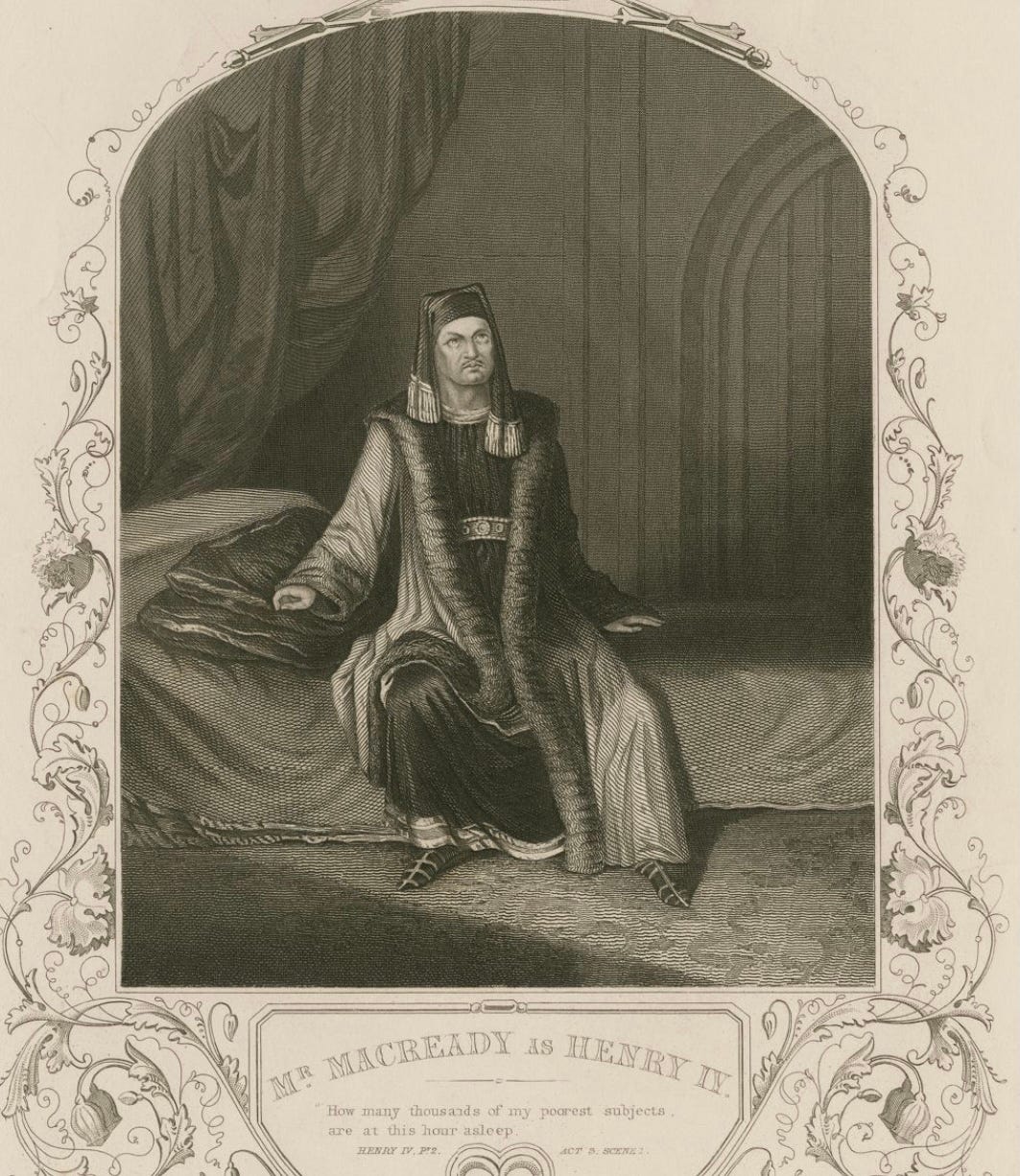
With the future of Henry IV’s kingdom uncertain, and his fears refusing to be quelled, the king is left to wonder how sleep, which is granted to the humblest of his subjects, can remain beyond the reach of royal power.
From William Shakespeare, Henry IV, Part 2
KING [...]

How many thousand of my poorest subjects
Are at this hour asleep! O sleep, O gentle sleep,
Nature’s soft nurse, how have I frighted thee,
That thou no more wilt weigh my eyelids down
And steep my senses in forgetfulness?
Why rather, sleep, liest thou in smoky cribs,
Upon uneasy pallets stretching thee,
And hushed with buzzing night-flies to thy slumber,
Than in the perfumed chambers of the great,
Under the canopies of costly state,
And lulled with sound of sweetest melody?
O thou dull god, why liest thou with the vile
In loathsome beds and leavest the kingly couch
A watch-case or a common ’larum bell?
Wilt thou upon the high and giddy mast
Seal up the shipboy’s eyes and rock his brains
In cradle of the rude imperious surge
And in the visitation of the winds,
Who take the ruffian billows by the top,
Curling their monstrous heads and hanging them
With deafing clamor in the slippery clouds
That with the hurly death itself awakes?
Canst thou, O partial sleep, give thy repose
To the wet sea-boy in an hour so rude,
And, in the calmest and most stillest night,
With all appliances and means to boot,
Deny it to a king? Then, happy low, lie down.
Uneasy lies the head that wears a crown.
What we love about this passage…
The King’s insomnia—an ordinary human predicament—becomes a moment of theatrical revelry. Henry’s restless thoughts give us a panoramic view of the kingdom as he imagines his people—from babies in cribs to sailors on stormy seas—blessed with sleep, while he himself—their king!—is denied it. His soliloquy briefly opens up an entire world for us to ponder as Henry wonders why not even money, power, and royalty can buy a good night’s sleep.
Sleep, or the lack of it, is a common theme in Shakespeare’s works, including Macbeth’s infamous insomnia (‘Macbeth doth murder sleep!’) and the deadly somnambulism of Lady Macbeth. Whether caused by guilt, responsibility, or a curse, sleeplessness in Shakespeare is vividly described, and we palpably feel the frustrations and fears that come with it.
About the author
William Shakespeare (1564-1616) was the author of at least 27 plays, including Hamlet, Macbeth, Richard III, Romeo and Juliet, A Midsummer Night’s Dream, Much Ado about Nothing, As You Like It, Othello, Henry IV parts 1 and 2, and The Tempest.
To read alongside...
Thomas Dekker gives a magnificent paean to sleep that works brilliantly alongside today’s Shakespeare excerpt:
“Do but consider what an excellent thing sleep is...that golden chain that ties health and our bodies together. Who complains of want? of wounds? of cares? of great men’s oppressions? of captivity? whilst he sleepeth? Beggars in their beds take as much pleasure kings: can we therefore surfeit on this delicate Ambrosia? Can we drink too much of that whereof to taste too little tumbles us into a churchyard, and to use it but indifferently throws us into Bedlam? No, no, look upon Endymion, the moon’s minion, who slept three score and fifteen years, and was not a hair the worse for it.”
A past newsletter features two very different reflections on sleep:
Or, how about theatre critic Michael Billington’s recent ranking of every Shakespeare play, published in The Guardian.
Suggest a LitHit!
Tell us your own favourites from literature you've read, and we can feature you as a Guest Curator. Just email us with the following information:
Your full name
The title of the book you're suggesting
The location of the excerpt within the book (e.g., "in the middle of chapter 5"), or the excerpt itself copied into the email or attached to it (in Word)
Why you love it, in just a few sentences
**Please note that we welcome all suggestions but at the moment we can only release excerpts that are out of copyright and in the public domain. This means 75 years or more since the author's death. You can find many such out-of-copyright texts on the internet, for example at Project Gutenberg and Standard Ebooks.
About LitHits
You might also enjoy...
Writers Make Worlds: https://writersmakeworlds.com/
The Ten Minute Book Club: https://www.english.ox.ac.uk/ten-minute-book-club
Project Gutenberg: https://www.gutenberg.org/
Standard Ebooks: https://standardebooks.org/
Feedback
We'd love to hear your thoughts on our newsletter:
kshepherdb@yahoo.co.uk
Graphic design by Sara Azmy
All curation content © 2026 LitHits. All rights reserved.