

Alchemy!
What begins as a careful experiment unfolds into something more dangerous

From Nathaniel Hawthorne, “The Birthmark”
The Story So Far…
Equipped with scientific knowledge, Aylmer believes perfection is within his grasp—until his obsession with erasing a tiny hand-shaped birthmark from his wife Georgiana turns love into a fatal experiment.
“Where am I? Ah, I remember,” said Georgiana, faintly; and she placed her hand over her cheek to hide the terrible mark from her husband’s eyes.
“Fear not, dearest!” exclaimed he. “Do not shrink from me! Believe me, Georgiana, I even rejoice in this single imperfection, since it will be such a rapture to remove it.”
“Oh, spare me!” sadly replied his wife. “Pray do not look at it again. I never can forget that convulsive shudder.”
In order to soothe Georgiana, and, as it were, to release her mind from the burden of actual things, Aylmer now put in practice some of the light and playful secrets which science had taught him among its profounder lore. Airy figures, absolutely bodiless ideas, and forms of unsubstantial beauty came and danced before her, imprinting their momentary footsteps on beams of light. Though she had some indistinct idea of the method of these optical phenomena, still the illusion was almost perfect enough to warrant the belief that her husband possessed sway over the spiritual world. Then again, when she felt a wish to look forth from her seclusion, immediately, as if her thoughts were answered, the procession of external existence flitted across a screen. The scenery and the figures of actual life were perfectly represented, but with that bewitching, yet indescribable difference which always makes a picture, an image, or a shadow so much more attractive than the original. When wearied of this, Aylmer bade her cast her eyes upon a vessel containing a quantity of earth. She did so, with little interest at first; but was soon startled to perceive the germ of a plant shooting upward from the soil. Then came the slender stalk; the leaves gradually unfolded themselves; and amid them was a perfect and lovely flower.
“It is magical!” cried Georgiana. “I dare not touch it.”
“Nay, pluck it,” answered Aylmer,—“pluck it, and inhale its brief perfume while you may. The flower will wither in a few moments and leave nothing save its brown seed vessels; but thence may be perpetuated a race as ephemeral as itself.”
But Georgiana had no sooner touched the flower than the whole plant suffered a blight, its leaves turning coal-black as if by the agency of fire.
“There was too powerful a stimulus,” said Aylmer, thoughtfully.
To make up for this abortive experiment, he proposed to take her portrait by a scientific process of his own invention. It was to be effected by rays of light striking upon a polished plate of metal. Georgiana assented; but, on looking at the result, was affrighted to find the features of the portrait blurred and indefinable; while the minute figure of a hand appeared where the cheek should have been. Aylmer snatched the metallic plate and threw it into a jar of corrosive acid.
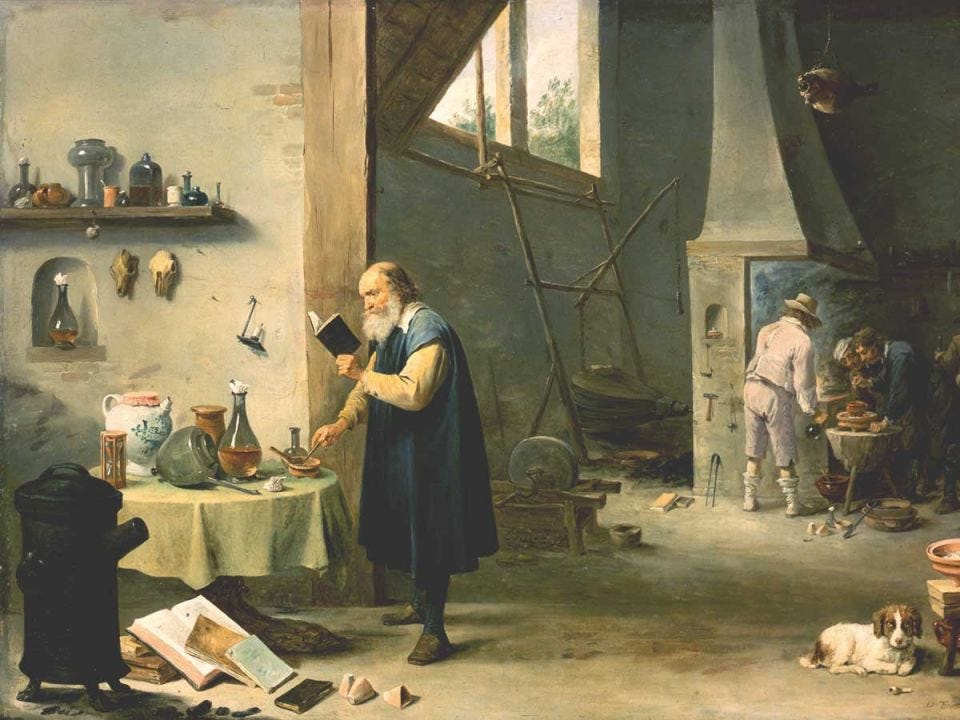
Soon, however, he forgot these mortifying failures. In the intervals of study and chemical experiment he came to her flushed and exhausted, but seemed invigorated by her presence, and spoke in glowing language of the resources of his art. He gave a history of the long dynasty of the alchemists, who spent so many ages in quest of the universal solvent by which the golden principle might be elicited from all things vile and base. Aylmer appeared to believe that, by the plainest scientific logic, it was altogether within the limits of possibility to discover this long-sought medium; “but,” he added, “a philosopher who should go deep enough to acquire the power would attain too lofty a wisdom to stoop to the exercise of it.” Not less singular were his opinions in regard to the elixir vitae.* He more than intimated that it was at his option to concoct a liquid that should prolong life for years, perhaps interminably; but that it would produce a discord in Nature which all the world, and chiefly the quaffer of the immortal nostrum,* would find cause to curse.
“Aylmer, are you in earnest?” asked Georgiana, looking at him with amazement and fear. “It is terrible to possess such power, or even to dream of possessing it.”
“Oh, do not tremble, my love,” said her husband. “I would not wrong either you or myself by working such inharmonious effects upon our lives; but I would have you consider how trifling, in comparison, is the skill requisite to remove this little hand.”
At the mention of the birthmark, Georgiana, as usual, shrank as if a redhot iron had touched her cheek.
*elixir vitae = the elixir of life
*nostrum = a medicine prepared by an unqualified practitioner (a quack)

What we love about this passage...
Hawthorne turns Aylmer’s science into a procession of fantastical images: figures made of light, reality projected onto a screen, life accelerated and perfected for display. These images, particularly the degree to which they conflict with real-life experience, make Georgiana uneasy. Aylmer, on the other hand, has faith that life and beauty can be perfected.
We love the way Hawthorne looks both forward and backward: he engages with various nascent forms and media here, for instance through the allusions to the screens with projections and the metal plate capturing an image through light rays, setting them alongside the ancient practice of alchemy. This juxtaposition forges a kind of sci-fi mode, and makes us think of Mary Shelley’s Frankenstein with its similarly deranged scientist harnessing a combination of old and new methods to carry out a dangerous, life-altering experiment.
And why is the birthmark shaped like a hand…?
About the author
Nathaniel Hawthorne (1804-64) was one of the pre-eminent American novelists of his era. His dark romances were often set in the colonial America of his ancestors and tested their Puritan ideology. In addition to The House of the Seven Gables, other popular works such as The Scarlet Letter (1850) brought him acclaim. He was active in the period often called the American Renaissance: an epoch before the Civil War, which saw a great outgrowth of literary talent in America and included authors such as Edgar Allan Poe, Herman Melville, Walt Whitman, Henry David Thoreau, Ralph Waldo Emerson, and Emily Dickinson (though she did not publish her poetry in her lifetime).
To read alongside...
Alchemy has a firm place in literature, often as an object of comedy. Ben Jonson’s The Alchemist (1610) skewers the gullible customers, or ‘gulls,’ who all too willingly believe the pseudo-scientific jargon of the purported ‘alchemist’ and eagerly part with their money in order to obtain the philosopher’s stone—the key to turning base metals into gold.
But an author who took alchemy very seriously indeed was Swedish playwright August Strindberg, who nearly killed himself carrying out dangerous alchemical experiments in his studio in Paris in the 1890s in what he later called his ‘Inferno’ period.
The birthmark at the centre of Hawthorne’s story makes us think of other literary works that explore a fixation with physical imperfection. One example is the 1888 short story by Thomas Hardy called ‘The Withered Arm,’ in which a milkmaid’s arm begins to shrivel and she believes it is because of a curse by her husband’s former lover.
Suggest a LitHit!
Tell us your own favourites from literature you've read, and we can feature you as a Guest Curator. Just email us with the following information:
Your full name
The title of the book you're suggesting
The location of the excerpt within the book (e.g., "in the middle of chapter 5"), or the excerpt itself copied into the email or attached to it (in Word)
Why you love it, in just a few sentences
**Please note that we welcome all suggestions but at the moment we can only release excerpts that are out of copyright and in the public domain. This means 75 years or more since the author's death. You can find many such out-of-copyright texts on the internet, for example at Project Gutenberg and Standard Ebooks.
About LitHits
You might also enjoy...
Writers Make Worlds: https://writersmakeworlds.com/
The Ten Minute Book Club: https://www.english.ox.ac.uk/ten-minute-book-club
Project Gutenberg: https://www.gutenberg.org/
Standard Ebooks: https://standardebooks.org/
Feedback
We'd love to hear your thoughts on our newsletter:
kshepherdb@yahoo.co.uk
Graphic design by Sara Azmy
All curation content © 2026 LitHits. All rights reserved.