

"Every day at sundown"
A short, but precise, poem about meetings and partings

Walt Whitman, “Out of the rolling ocean the crowd”
Out of the rolling ocean the crowd came a drop gently to me,
Whispering, I love you, before long I die,
I have travell’d a long way merely to look on you to touch you,
For I could not die till I once look’d on you,
For I fear’d I might afterward lose you.

Now we have met, we have look’d, we are safe,
Return in peace to the ocean my love,
I too am part of that ocean, my love, we are not so much separated,
Behold the great rondure, the cohesion of all, how perfect!
But as for me, for you, the irresistible sea is to separate us,
As for an hour carrying us diverse, yet cannot carry us diverse forever;
Be not impatient – a little space – know you I salute the air, the ocean and the land,
Every day at sundown for your dear sake, my love.
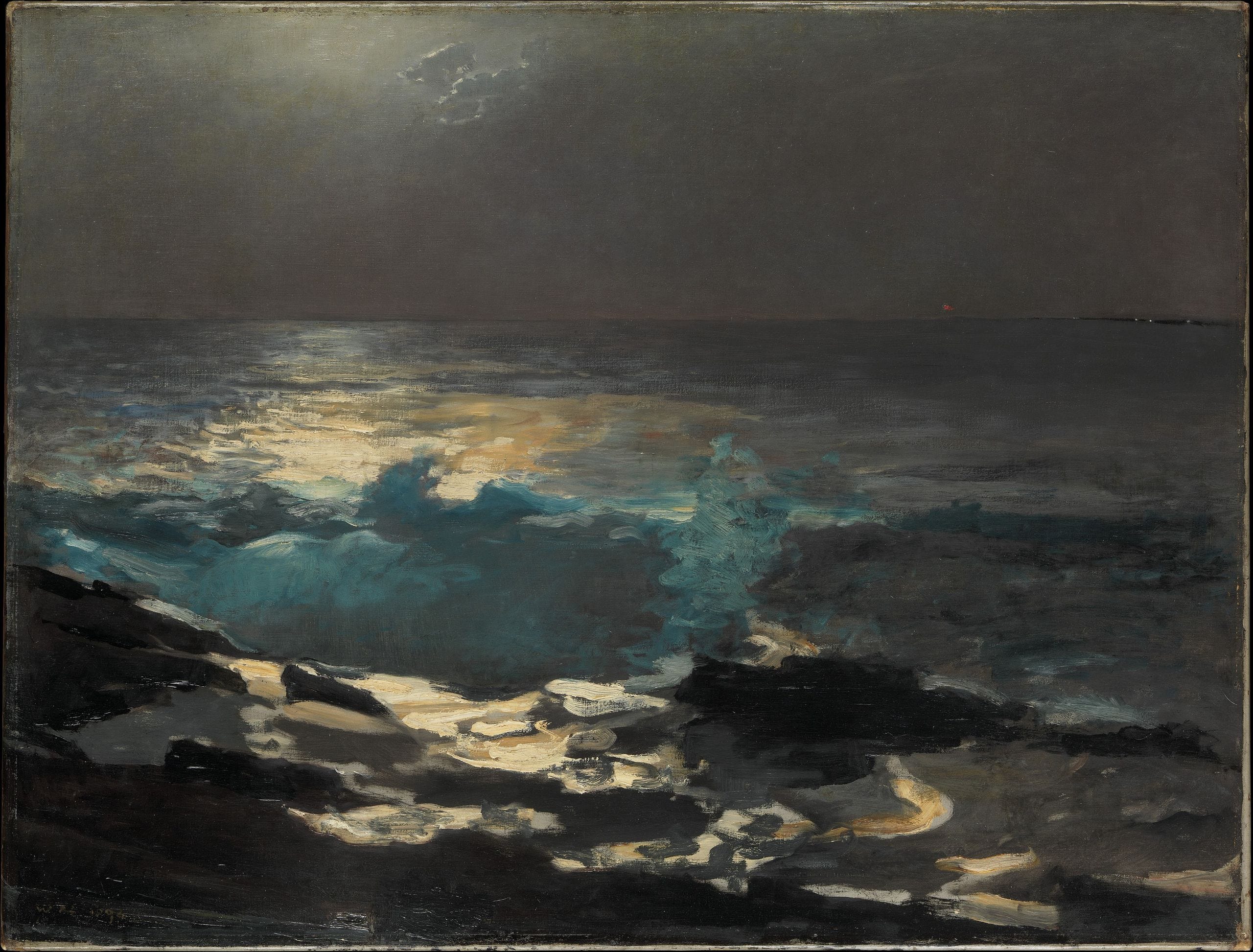
What we love about this passage...
A single drop of water is personified and given speech. It tells us it has traveled a great distance for one purpose only: to look upon a beloved face before it disappears. It is like a message in a bottle, ephemeral and evanescent. The poet receives this gesture with gratitude, if somewhat formally, returning it through a quiet, nightly salute to the tiny drop. The speech gives the the impersonal sea a romantic and familiar intimacy.
Whitman’s use of the elevated “rondure”, which means a graceful curve or roundness, is perhaps surprising, but it helps the image he is drawing ultimately come off: two people may be physically separated but somehow still connected, through this arc, like distinct parts of the same sea.
The poem’s emphasis on movement, distance, and return also echoes natural patterns familiar from the ocean world—sea birds and turtles that travel far only to find their way back again.
About the author
Walt Whitman (1819–1892) is considered among the United States of America’s greatest poets. His publication of Leaves of Grass in 1855 brought him immediate attention—along with controversy—and even a positive review anonymously penned by the entrepreneurial and audacious Whitman himself. His literary forerunner, the American writer Ralph Waldo Emerson, famously wrote to him: “I greet you at the beginning of a great career.” Whitman was also popular in Britain, where some of his earliest and most enthusiastic supporters included Oscar Wilde.
To read alongside...
Virginia Woolf’s The Waves (1931) is an innovative novel whose structure evokes the rolling waves of the sea as the individual characters’ interior narratives blend into one another to create a single voice. She challenges conventions of plot, character, and narrative voice in fiction through this single unifying metaphor of waves.
Suggest a LitHit!
Tell us your own favourites from literature you've read, and we can feature you as a Guest Curator. Just email us with the following information:
Your full name
The title of the book you're suggesting
The location of the excerpt within the book (e.g., "in the middle of chapter 5"), or the excerpt itself copied into the email or attached to it (in Word)
Why you love it, in just a few sentences
**Please note that we welcome all suggestions but at the moment we can only release excerpts that are out of copyright and in the public domain. This means 75 years or more since the author's death. You can find many such out-of-copyright texts on the internet, for example at Project Gutenberg and Standard Ebooks.
About LitHits
You might also enjoy...
Writers Make Worlds: https://writersmakeworlds.com/
The Ten Minute Book Club: https://www.english.ox.ac.uk/ten-minute-book-club
Project Gutenberg: https://www.gutenberg.org/
Standard Ebooks: https://standardebooks.org/
Feedback
We'd love to hear your thoughts on our newsletter:
kshepherdb@yahoo.co.uk
Graphic design by Sara Azmy
All curation content © 2026 LitHits. All rights reserved.