

Power and Frailty
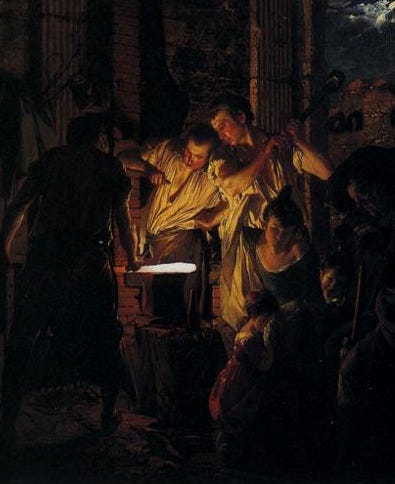
Gerard Manley Hopkins was a Catholic priest as well as a poet, and was once called on to minister to a dying man, Felix Randal, a blacksmith ('farrier').
Gerard Manley Hopkins, ‘Felix Randal’
Felix Randal the farrier, O is he dead then? my duty all ended,
Who have watched his mould of man, big-boned and hardy-handsome
Pining, pining, till time when reason rambled in it, and some
Fatal four disorders, fleshed there, all contended?

Sickness broke him. Impatient, he cursed at first, but mended
Being anointed and all; though a heavenlier heart began some
Months earlier, since I had our sweet reprieve and ransom
Tendered to him. Ah well, God rest him all road ever he offended!

This seeing the sick endears them to us, us too it endears.
My tongue had taught thee comfort, touch had quenched thy tears,
Thy tears that touched my heart, child, Felix, poor Felix Randal;

How far from then forethought of, all thy more boisterous years,
When thou at the random grim forge, powerful amidst peers,
Didst fettle for the great grey drayhorse his bright and battering sandal!
What we love about this poem…
In the first line, the news of Randal’s death shocks Hopkins, even though it was expected, and he goes on to hammer out feelingly and precisely the shifting nature of the relationship between the two men during Randal’s ordeal. Hopkins finally ‘touched’ Randal with his ministry; but he himself was equally ‘touched’ by Randal’s reception of it. So the poem is a progress towards the very moving realisation of the mutuality of their emotional and spiritual responses––almost as if the sacrament has worked in both directions. To help portray this coming together, he open-heartedly mingles his own standard English with Randal’s words and phrases in Lancashire dialect: ‘all road’; ‘fettle’; ‘and all’; and ‘sandal’ which is a farrier’s word for a specific type of horseshoe.
The final two lines are a powerful evocation of Randal in all the magnificence of his physical strength when he worked at the forge. Hopkins’s use of stress to evoke sound is very evident in the final line, with its six strong stresses: Great, Grey, Dray …; Bright, Batt …, Sandal. These are surely two sets of three hammer-blows on the anvil.
About the Author
Gerard Manley Hopkins (1844-89) wrote poetry that was radical in style, bearing no resemblance to the work of his contemporaries. He sought to define scrupulously his keen sensory and emotional response to his subjects, and to do so, handled vocabulary, metre, and rhythm in bold and imaginative ways to make plain his precise meaning.
To read alongside…
Read our past newsletter featuring Gerard Manley Hopkins, which begins with the memorable line ‘Glory be to God for dappled things –’
Curator’s Corner
Derek Nicholls has spent his working life in the theatre: as director and producer in subsidised and commercial sectors, running theatres across the UK. Having read English at Oxford, he is thrilled to have uninterrupted opportunity in retirement to focus again on English Literature, his first love, alongside Western European art and history––particularly all aspects of the Italian Renaissance, and the seventeenth century, historically and culturally.
Suggest a LitHit!
Tell us your own favourites from literature you've read, and we can feature you as a Guest Curator. Just email us with the following information:
Your full name
The title of the book you're suggesting
The location of the excerpt within the book (e.g., "in the middle of chapter 5"), or the excerpt itself copied into the email or attached to it (in Word)
Why you love it, in just a few sentences
About LitHits
Our curation is entirely human, done by our little team of Kirsten, Alex, and Daniel.
You might also enjoy...
Feedback
We'd love to hear your thoughts on our newsletter:
kshepherdb@yahoo.co.uk
Graphic design by Sara Azmy
All curation content © 2026 LitHits. All rights reserved.