

Pride, Prejudice, and 'Passing'
An enchanting encounter with an old acquaintance throws everything into disarray

From Nella Larsen, Passing (1929)
The story so far…
A chance encounter brings protagonist Irene Redfield face-to-face with her childhood friend Clare Kendry. Clare tells Irene of how she lives ‘passing’ as a white woman, married to a racist white man completely unaware of Clare’s real background and identity. After telling her story, Clare asks Irene, who is similarly light-skinned, about her thoughts on ‘passing’ as a white woman.
Now read on…
“But you’ve never answered my question. Tell me, honestly, haven’t you ever thought of ‘passing’?”
Irene answered promptly: “No. Why should I?” And so disdainful was her voice and manner that Clare’s face flushed and her eyes glinted. Irene hastened to add: “You see, Clare, I’ve everything I want. Except, perhaps, a little more money.”
At that Clare laughed, her spark of anger vanished as quickly as it had appeared. “Of course,” she declared, “that’s what everybody wants, just a little more money, even the people who have it. And I must say I don’t blame them. Money’s awfully nice to have. In fact, all things considered, I think, ‘Rene, that it’s even worth the price.”
Irene could only shrug her shoulders. Her reason partly agreed, her instinct wholly rebelled. And she could not say why. And though conscious that if she didn’t hurry away, she was going to be late to dinner, she still lingered. It was as if the woman sitting on the other side of the table, a girl that she had known, who had done this rather dangerous and, to Irene Redfield, abhorrent thing successfully and had announced herself well satisfied, had for her a fascination, strange and compelling.
Clare Kendry was still leaning back in the tall chair, her sloping shoulders against the carved top. She sat with an air of indifferent assurance, as if arranged for, desired. About her clung that dim suggestion of polite insolence with which a few women are born and which some acquire with the coming of riches or importance.
Clare, it gave Irene a little prick of satisfaction to recall, hadn’t got that by passing herself off as white. She herself had always had it.
Just as she’d always had that pale gold hair, which, unsheared still, was drawn loosely back from a broad brow, partly hidden by the small close hat. Her lips, painted a brilliant geranium-red, were sweet and sensitive and a little obstinate. A tempting mouth. The face across the forehead and cheeks was a trifle too wide, but the ivory skin had a peculiar soft lustre. And the eyes were magnificent! dark, sometimes absolutely black, always luminous, and set in long, black lashes. Arresting eyes, slow and mesmeric, and with, for all their warmth, something withdrawn and secret about them.
Ah! Surely! They were Negro eyes! mysterious and concealing. And set in that ivory face under that bright hair, there was about them something exotic.
Yes, Clare Kendry’s loveliness was absolute, beyond challenge, thanks to those eyes which her grandmother and later her mother and father had given her.
Into those eyes there came a smile and over Irene the sense of being petted and caressed. She smiled back.
“Maybe,” Clare suggested, “you can come Monday, if you’re back. Or, if you’re not, then Tuesday.”
With a small regretful sigh, Irene informed Clare that she was afraid she wouldn’t be back by Monday and that she was sure she had dozens of things for Tuesday, and that she was leaving Wednesday. It might be, however, that she could get out of something Tuesday.
“Oh, do try. Do put somebody else off. The others can see you any time, while I—Why, I may never see you again! Think of that, ‘Rene! You’ll have to come. You’ll simply have to! I’ll never forgive you if you don’t.”
At that moment it seemed a dreadful thing to think of never seeing Clare Kendry again. Standing there under the appeal, the caress, of her eyes, Irene had the desire, the hope, that this parting wouldn’t be the last.
“I’ll try, Clare,” she promised gently.
What we love about this passage…
At the start of the passage, Irene is confronted with (and seemingly surprised by) her own perspectives on racial identity. The reader might also be surprised by Irene’s vehement rejection of ‘passing’, considering both Irene and Clare are currently sat in a rooftop cafe ‘passing’ as white. As the extract progresses, Larsen presents Irene’s admiring and potentially desiring depictions of Clare’s mixed-race appearance, followed by a parting scene that would not be out-of-place between two blushing lovers desperate to see each other again. Larsen’s excellent use of dialogue teases out indications of homosexuality, while expressing the tensions and delight underpinning the scene in such an economy of words.
This short extract gives us an insight into Irene and her vascilating views towards sexuality, identity, and complacency which are essential to the novel, whose plot is driven by the fears and desires of its protagonist. In a signed copy addressed to her colleague Regina Anderson, Nella Larsen fittingly describes the novel as a ‘tale of pride, prejudice, and “passing”’.
About the author
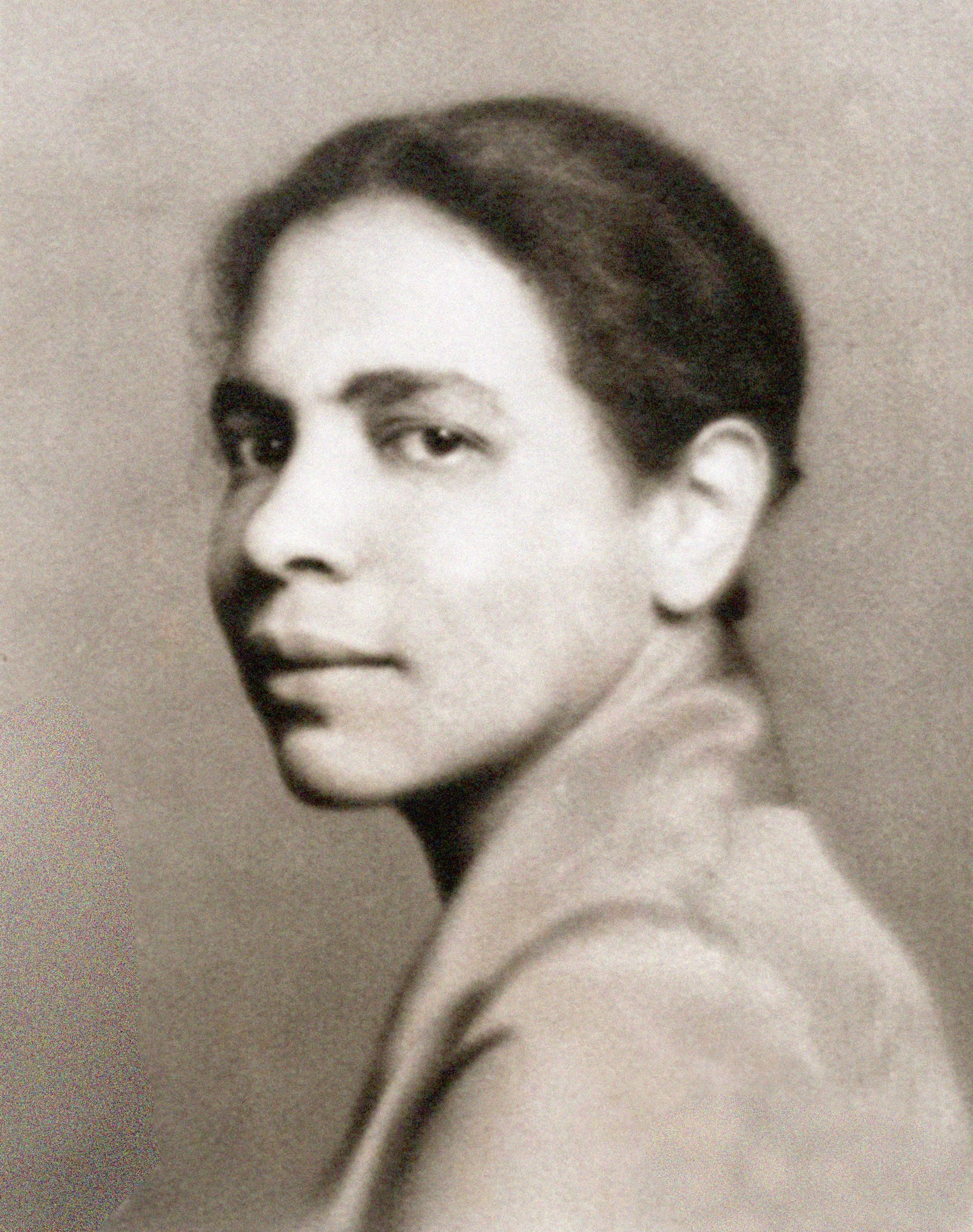
Nella Larsen (1891-1964) was an important novelist of the Harlem Renaissance and American modernism. She was the only mixed-race member of a primarily white family and spent her life between white and black communities in America and Denmark. She worked as a nurse and a librarian, and she published two novels: Quicksand and Passing. Her literary career was short-lived, following a plagiarism scandal around her short story ‘Sanctuary’. Her novels, after their initial warm reception, faded into obscurity until interest in her writings was revived in the late 20th Century. Her work is now known for its exploration of sexuality, race, psychology, and literary originality and ownership.
To read alongside…
There is a rich seam of literature that deals with ‘passing.’ An early example is William Wells Brown’s novel Clotel; or, The President's Daughter (1853), in which several characters ‘pass’ as white in order to escape slavery. James Weldon Johnson’s The Autobiography of an Ex-Colored Man (1891) depicts the psychological cost of relinquishing one’s Black identity as the narrator ultimately chooses to pass as white. In Mark Twain’s novel Pudd’nhead Wilson (1894), an enslaved woman switches her own light-skinned child with her master's son, so the enslaved child grows up as white. The novel exposes race as a social rather than biological category. Jessie Redmon Fauset’s Plum Bun (1928) was published just a year before Passing and is one of its most important predecessors, centring on a woman who chooses to live as white in order to gain social and professional advantages.
George Schuyler’s satirical novel Black No More (1931) uses the techniques of speculative fiction to expose the absurdity of racial categories: rather than ‘passing’, African Americans can undergo a medical procedure to become white. You can read the entire novel here.
You might also enjoy our past newsletter about the real-life story of how Ellen Craft escaped from slavery by ‘passing’ as a white man:
The amazing, cross-dressing escape of Ellen Craft

William and Ellen Craft, Running a Thousand Miles for Freedom
And finally, for other texts with similarly subtle explorations of same-sex desire as this excerpt from Passing, why not try Katherine Mansfield’s short story ‘Bliss’ or Virginia Woolf’s novel Mrs Dalloway?
About the Curator
Dr Natasha A. J. Bradley is an early career researcher and member of the English Faculty at the University of Oxford. A recent addition to the LitHits curation team, her research focuses on medieval literature, specifically Old Norse literature, and she has published on topics such as gender and translation. In addition to her medieval focus, she loves reading (and teaching) literature across all periods.
Suggest a LitHit!
Tell us your own favourites from literature you've read, and we can feature you as a Guest Curator if you like. Just email us with the following information:
Your full name
The title of the book you're suggesting
The location of the excerpt within the book (e.g., "in the middle of chapter 5"), or the excerpt itself copied into the email or attached to it (in Word)
Why you love it, in just a few sentences
About LitHits
LitHits helps you make time for reading by bringing you unabridged excerpts from brilliant literature that you can read on the go, anytime or any place. Our curators carefully select and frame each excerpt so that you can dive right in. We are more than a book recommendation site: we connect you with a powerful, enduring piece of literature, served directly to your mobile phone, tablet or computer.
You might also enjoy...
Feedback
We'd love to hear your thoughts on our newsletter:
kirsten.shepherd@ell.ox.ac.uk
Graphic design by Sara Azmy
All curation content © 2026 LitHits. All rights reserved.